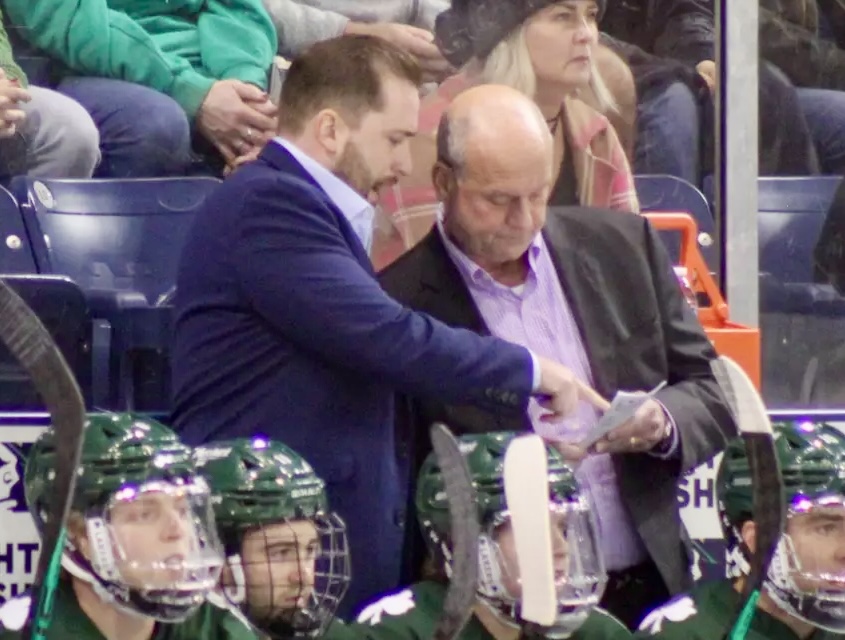
Barring a miracle, the Mercyhurst men’s hockey program essentially started and ended with Rick Gotkin.
His tenure at Mercyhurst began in 1988 shortly after the school began its transition from club to NCAA Division III. The Lakers were at various times D-III and D-II before making the move to Division I in 1999.
As a D-I program, Mercyhurst won two MAAC regular season and playoff championships before the conference transitioned to Atlantic Hockey, where Gotkin’s team claimed two regular season and one playoff championship.
Gotkin announced his retirement before the 2025-26 season, and the Lakers ended their latest campaign with a 6-28-3 record, losing to eventual champ Bentley in the Atlantic Hockey quarterfinals. Gotkin’s contract runs through June 1. His career record at Mercyhurst was 617–578–114.
Less than a week after the Lakers’ season ended, the school announced that it was eliminating its men’s hockey program effective immediately.
For Gotkin, who is also in his last year serving on the D-I NCAA Hockey Championship committee (ironically replacing RMU coach Derek Schooley, who had to step off the committee when Robert Morris ended its programs in 2021 before reinstating them two years later), it is a time to reflect on a more than 40-year career in college hockey, most of it spent in Erie, Pa., with Mercyhurst.
“I was an assistant at Rensselaer,” said Gotkin, who played college hockey at D-III Brockport. “I wanted to continue to try to evolve, so I applied for a couple of head coaching jobs at smaller schools.”
Mercyhurst hired Gotkin in 1988 to coach the D-III Lakers. In the early days, Rick ran the entire operation, with the help of his wife, Diane.
“When we were getting ready to go on the road, if we were going to (for example) RIT, we would leave on a Thursday or even a Friday morning,” he said. “My wife and I would start (filling) this big steamer trunk. And she knew exactly how many (tape) rolls it took and how many pairs of skate laces. She knew how many pairs of socks, the jerseys, and she would fold them. We would put the socks together. We’d seal this trunk, and be ready to go.
“Then we’d come home on Saturday night or Sunday morning. We had to get the jerseys and socks washed. We used to drag them across campus, because there was only one washer and dryer. The rink didn’t exist back then. And if we were going back on the road on Thursday, we’d do it all over again.”
The Mercyhurst Ice Center opened in 1991 and Gotkin got some additional help, and after a decade as a successful D-III and D-II period, the program went D-I and joined the inaugural season of the MAAC Hockey conference, which transitioned to Atlantic Hockey in 2003.
Crowned MAAC champions in 2001, Mercyhurst’s trip to the NCAA tournament that year changed everything, according to Gotkin. The Lakers fell to Michigan 4-3 in the first round at the Grand Rapids Regional, but gave the Wolverines all they could handle. While not a win, it helped the school and conference in terms of visibility and credibility.
“Our whole city was completely wrapped up with the Mercyhurst hockey program playing Michigan,” said Gotkin. “This was David and Goliath all the way, right. Right? We showed that we absolutely belonged.”
That season’s success brought Gotkin more resources from the school.
“I had one assistant,” he said. “We didn’t have anything, like hockey operations people or equipment managers. We got an equipment manager after we played Michigan in 2001, as people at the tournament couldn’t believe that we didn’t have anyone. You know, I was walking around picking up pucks in Grand Rapids after the practice. So 2001, that changed everything.”
But coaching a small school in the NCAA tournament was always interesting.
“At the 2005 tournament, we played (Boston College) in Worcester,” said Gotkin. “We have no band. Still don’t have a band. I called (then head coach) Paul Pearl at Holy Cross. I’m like, ‘Paul, I’m trying to get a band.’ He goes, ‘We’re gonna be on spring break. We are not gonna have any students here.’
“But then he said, ‘Hey, try my old high school, St. John Shrewsbury, ask for Joe, the band leader.’
“I tell them who we are, we’re coming to play the NCAA tournament, obviously, they all know hockey and college hockey. And I said, ‘I could even give you a little bit of money, you know?’ And he said, ‘Yeah, we would love that. Could you get us hockey jerseys to wear?’ I was thinking, well, I’ve got a green set of jerseys and a white set of jerseys, and we’re gonna be wearing green against Boston College. So we gave them the whites.”
But after the game, a 5-4 loss to BC, Gotkin had a bit of an issue getting the jerseys back.
“So the game ends. It is pouring rain. I’m doing the press conference, and all of a sudden, I see the band kids, all with their instruments, and the jerseys. I’m like, ‘Oh my God. My jerseys are walking out the door.’ I am in the parking lot, in the rain, chasing these kids around. ‘Excuse me. I’d like my jersey back.’ Like, we gotta wear those next year for home games.”
Gotkin has coached several players that went on to successful hockey careers, including Jamie Hunt (2003-06) who played a single NHL game with Washington, and All-American Joe Dusak (2016-19), currently in the KHL.
But changes to the college hockey landscape caused Gotkin to re-assess his approach in the age of larger schools cherry-picking his best players via the transfer portal, sometimes enticed by NIL money. For example, goaltender Kyle McClellan (2020-22) transferred to Wisconsin after two impressive years in Erie, winning the Richter Award as the top collegiate goalie in 2024.
“We tried to kind of reinvent ourselves a little bit through the transfer portal,’ said Gotkin. “We try to say to kids, ‘Listen, we get it. Mercyhurst might not be your final destination. Come to Mercyhurst, play really well, be really good, and then move on. Go to your destination.’
“But the catch is, you gotta be really good.”
Even with those adjustments, and despite his program acting as the forerunner to what is now a fully D-I athletic department, the school elected to kill men’s hockey at the end of this past season.
Is it really the end? Gotkin says he’s holding out hope.
“There’s a group of people,” said Gotkin, of a group put together to save Mercyhurst hockey. “I think it’s a big group. They were able to raise, I think, almost $350,000, in about four days.
“But I believe what they’re going to need to raise is about a million and a half to be able to sustain the first two years of hockey. When and if it ever comes back, and then, eventually, try to raise upwards of 10 million to somehow endow the program.”
What’s next for Gotkin, who turns 67 in November?
“I’m not sure,” he said. “I know I don’t want to coach. That part’s done. I did that. I loved it. I loved the kids.
“A part-time scouting job?. Maybe. (Moving to) Florida, for sure.”
Whatever his future holds, Gotkin says he has no regrets.
“I’ve been really fortunate,” he said. “I got to do something that I absolutely loved. And I got to do that in a place I loved in Mercyhurst. And to be able to do that for 38 years, in the same place, I’m very blessed.”